This article is from The Star newspaper dated 14 April 2013.
It’s striking sometimes how similar the supernatural creatures and lores of cultures that seem far apart from each other are.
VARIOUS cultures around the world, especially those centred upon, or
derived from, animism have beliefs in the supernatural, of things and
events incomprehensible to the human mind. It is a cultural universal,
and we are all familiar with frightening stories of things that go bump
in the night.
Whether we choose to believe in them or not, we are
always surrounded by tales of the supernatural, in literature or
movies, or from personal accounts of friends and families.
This
fascination with the unknown gave rise to the subculture of ghost
hunting and the camping tradition of telling ghost stories.
Some
cultures even celebrate the dead (and the undead), like the Chinese
Hungry Ghost Festival, the Mexican Day of the Dead and, of course,
Halloween. In Japanese folklore, every year, ghouls and ghosts take to
the streets during the summer nights. It is known as Hyakki Yagy (Night
Parade of 100 Demons).
Hyakki Yagy is a famous theme in Japanese
art. On these days, the ghouls and ghosts come out to play, and
supernatural occurrences are at their peak. Recently, I picked up Yokai Attack! The Japanese Monster Survival Guide for a fun read, and interestingly, I can’t help but make comparisons to our own versions of yokai, the supernatural creatures of Japanese folklore. One of them is the zashiki warashi,
a child poltergeist who haunts and inhabits houses. Although it loves
to play pranks on people, it is considered harmless. The Japanese
believe that a zashiki warashi brings good fortune to the house it
inhabits and that the family will prosper as long as it stays.
But
if the house is neglected, then the child spirit will leave, and that’s
when the real problem comes. As it leaves the house, so does the good
fortune and the family will be left in ruins – bankruptcy, disaster,
domestic strife.
Zashiki warashi is very much like our toyol. The toyol
is a child-like ghoul believed to be a manifestation of an unborn
child. It is kept by its master to do his or her bidding, usually
stealing or other petty crimes. It’s commonly rumoured that whenever
someone becomes rich that the person is keeping a toyol. The toyol, like
the zashiki warashi, loves to play pranks on people but is considered
harmless.
Nuke kubi is a female creature who can fully
detach her head from her body. She looks like a normal woman during the
day but turns into nuke kubi at night, with her head flying off in
search of human prey. Because of her appearance as a woman during the
day, it is thought that the nuke kubi may have human spouses.
To
kill a nuke kubi, one needs to find her immobile body and move it
somewhere else. The nuke kubi will die if she cannot reconnect with her
body by sunrise.
Again the nuke kubi is strikingly similar to our penanggalan,
a flying head with its intestines attached. It is believed that the
penanggalan is a woman who practices black magic. The woman is able to
detach her head, along with her intestines, from her body, and flies in
the dead of the night in search of blood, preferably from an infant or a
woman giving birth.
To kill a penanggalan, one needs to find her
headless body, fill it with broken glass and nails so that when she
tries to reattach to her body, her intestines will be severed by the
sharp objects.
Penanggalan has many other variations in other South-East Asian countries like Thailand, Indonesia and the Philippines.
Sceptics
and non-believers usually apply logic and common sense to brush aside
beliefs in the supernatural. Perhaps there are certain explanations for
these happenings, like sleep paralysis where our mind is aware but our
body shuts down. It’s logical for those who have experienced it to claim
that they have been held down by a spirit while sleeping.
And
often in fear, our mind plays tricks and we may conjure images or
shadows that would further intensify our own fears. Often stories like
this would end with the person praying and the spirit going away, but
praying is a form of meditation and helps calm the body down, hence
“releasing” the spirit.
Some stories of ghosts are lessons or advice to children, like the hantu kopek
who preys on children at night. It’s probably so children are
encouraged to come home by dusk or else risk being kidnapped by this
creature.
Or like the Japanese kappa, a water yokai who
drowns children lest they swim too far out. Both these stories are
intended to scare children for their own safety.
But I’d like to
think that we’re not the only beings living in this world, or worlds.
The human eye is limited and there is still so much more that humans do
not know about this world. Do we brush aside the possibility of the
otherworldly just because we can’t see, or refuse to see?
Saturday, April 13, 2013


Friday, April 05, 2013
The Origin of Qing Ming
Qīng Míng Jié (literally “Clear, Bright Festival”) is said to originate from Hánshí (寒食 - cold meal) Festival, which dates back to the Spring and Autumn Period in China (722 - 481 B.C.). Qing Ming falls on the 104th day after the winter solstice (or the 15th day from the Spring Equinox). This year Qing Ming falls on 4th April 2013.
The day commemorates a man called Jie Zitui, who was a loyal follower of Duke Wen during the Jin State. Unfortunately, due the turmoil of the state at the time, Duke Wen (who was not yet a Duke at that point) was exiled and spent the next 19 years living nomadically with Jie, scraping by on nothing but the bare minimum of life’s necessities.
At one point, the Duke became so close to the point of starvation that Jie cut a piece of flesh from his thigh to make a soup for Wen. The soup ended up saving Wen’s life, and the Duke was so touched at Jie's sacrifice that he promised to reward Jie later on.
Eventually, Wen reclaimed his position on the throne and became the Duke of Jin State. He proceeded to reward all those who assisted him in reclaiming his position, however, for some reason he left out Jie. When reminded of the life-saving soup Jie made for him in dire need, the Duke became regretful and went out in search of Jie to reward him. It was at that time that the Duke had learned Jie had moved to some remote forest with his mother.
Unable to locate Jie himself, he ordered his men to set the forest on fire in attempt to force Jie out so that he could reward Jie and rid his own feelings of guilt. The fire, however, ended up doing just the opposite and burned Jie, along with his mother, alive.
Realizing the error of his ways and feeling remorseful over the loss of Jie, Duke Wen from there on order 3 days of the year to be held without fire (Hanshi Festival) in order to commemorate Jie Zitui’s death.
Today, Hanshi Festival has been combined with Qing Ming Festival, whereby not only Jie Zitui is remembered, but all ancestors in general. It is a holiday for families to honor their ancestors at their grave sites, hence the English translation of the term “Tomb Sweeping Holiday”.
Monday, March 30, 2009
How to avoid ghosts in hotel rooms
Ok, here are some beliefs of the hoteliers...
There is at least one permanent room which should be left vacant at all times. No matter how full the hotel is, they are not to sell that room(s) to any guest. It is said that the special room is 'reserved' for those 'special visitors'.
So, if you plan to stay in some hotel, always book in advance. Try to avoid walk-ins. If the receptionist tells you there's no more room available, do not insist to get one anymore or try to bribe them to give you a room. If you do that, most of the time the room you have will be that 'special room'.
Sometimes those 'special visitors' might go to other rooms also, so here's some tips on how to protect yourself.
Before entering your room, always knock on the door first, even if you know the room is vacant.
After you enter the room, if you feel very cold suddenly and have 'chicken spore', leave the room quietly immediately and go to the reception to request to change room. Most of the time, the receptionist will understand what's happening.
After you enter the room, immediately switch on all of the lights, and open the curtain to let the sunlight in.
Before you go to bed, arrange your shoes so that one of them is upside down. Some say this represents yin and yang to protect you while you're asleep.
Always leave at least a lamp on while you're sleeping, preferably the toilet lamp.
If you' re staying alone and they have give you a twin bed, do not sleep with the other bed vacant, try to put your things like luggage, on the other bed before you sleep.
When you enter your hotel room, look for the Bible. Most hotels place the Bible inside a drawer, however, if upon entering, you see the Bible on the table, DON'T STAY IN THAT ROOM. It means 'special visitors' are there.
If you see the Bible opened up on the table, LEAVE THAT ROOM IMMEDIATELY and request for a change of room! It means the 'special visitor' is really creating trouble in that room!
Monday, February 23, 2009
The Boy and the Magic Stone
Muhammad Ponari, a 9-year-old boy from Jombang, East Java, Indonesia had been playing in the rain in his front yard when he was hit by a thunderbolt. When he came to, he found a stone the size of an egg. He had reportedly placed the stone in a glass of water, which was later gulped down by his cousin. The cousin, who had been ill for quite sometime, was then cured of his raging high fever.

Then another neighbour approached him - a woman in her 30s who had suffered from a depressive condition for 15 years. She, too, was healed.
The miracles, large and small, kept coming, said Nila Retno, the local village chief.
"My arm was sprained. The water touched by stone was given to me and I applied the water to my sprained arm. Suddenly, I was OK again," she said.

The district police commissioner, Sutikno, a devout Muslim who will be making the Haj pilgrimage to Mecca this year, told of his experience.
"I was inside the house talking to the boy and his family. Together with me in the house was a boy of his age who had not spoken for five years," he said.
"Ponari shook him. The boy reacted and they started fighting, like wrestling and pulling each other's hair. Then, a few moments after the fighting, the boy started to talk."
What did he say? "He said 'I'm scared' in Javanese — but he talked."
The tales of miraculous healings spread. Within a week of the lightning strike, hundreds of villagers were lining up outside Ponari's modest home.
A week later, the ailing, the lame and the curious were coming from as far afield as Malaysia. Thousands queued each day in lines stretching for kilometres, carrying plastic bags of water ready to be transformed into an elixir by the magical stone.
Stampedes erupted on at least three occasions, resulting in the deaths of three people and injuries to dozens more.

The public disorder forced police to remove the boy to an undisclosed location. Ponari has stopped administering his miracle cures this week after tending to tens of thousands of patients.
Even so, as much as 1 billion rupiah ($A120,000) has been raised through a charity box outside his home. This, many adherents to mysticism believe, was poor form indeed. Dukuns (or shamans) are not supposed to profit from their activities.
According to village chief Retno, Ponari himself said he had been "scolded" by the stone for accepting cash. "He said he felt that his whole body was whipped," she said.
Is this a hoax, a miracle or just the power of the mind?
Tuesday, November 25, 2008
More people believe in Aliens and Ghosts than in God
This article is from Yahoo! News:
More people believe in aliens and ghosts than in God, a new survey finds, according to a British newspaper.
The survey, however, was done by a marketing firm in conjunction with the release of an X-Files DVD, and details of how the poll was conducted were not reported in the Daily Mail. Survey questions, depending on how they are written, can greatly skew results, along with how subjects are sampled.
That said, the poll of 3,000 people found that 58 percent believe in the supernatural, including paranormal encounters, while 54 percent believe God exists. Women were more likely than men to believe in the supernatural and were also more likely to visit a medium.
Indeed, humans are prone to believing in things they can neither see nor find logical evidence for.
A survey of U.S. college students done in 2006 found 23 percent of freshmen had a general belief in paranormal concepts - from astrology to communicating with the dead. Interestingly, the number jumped to 31 percent among seniors and 34 percent among graduate students.
Researchers who have compared various human belief systems say our tendency to believe is deeply rooted.
"While it is difficult to know for certain, the tendency to believe in the paranormal appears to be there from the beginning," said Christopher Bader, a Baylor University sociologist. "What changes is the content of the paranormal. For example, very few people believe in faeries and elves these days. But as belief in faeries faded, other beliefs, such as belief in UFOs, emerged to take their place."
Religion and belief in the paranormal are not linked as one might imagine. A handful of surveys show just the opposite, in fact.
"Paranormal beliefs are very strongly negatively related to religious belief," said Rod Stark, another Baylor researcher. Some scientists think this is so because religions tend to discourage paranormal beliefs, and indeed most devout practitioners of a religion have been shown to be the least likely to believe in Bigfoot, ghosts or aliens.
Tuesday, August 21, 2007
'Ghost' Bride
What is a 'ghost' bride?
In the days dating back to before the Han dynasty, when a single man passes away, custom calls for him to be married posthumously to a deceased single woman so that he will not be alone in the afterlife. It was believed that if the deceased man is unmarried, he can come back to haunt their living relatives and cause misfortune.
The tradition is still in practice today. In 1998, a farmer was caught stealing female corpses from their graves, mostly freshly upon their death. He sold the bodies for less than 4,000 yuan each to traffickers, who passed them to intermediaries, known as matchmakers for ghosts, who marked them up more than three times for the final customers.
Female corpses have become comparatively rare due to the substantial gender imbalance brought on by China’s one-child policy.
In January this year, the tradition took a heinous turn when police in northern China detained 3 men for the killings of two women whose corpses were then sold as "ghost brides". Yang Donghai, a 35-year-old farmer in western China's Shaanxi province, confessed to killing a woman bought from a poor family for 12,000 yuan last year. She thought she was being sold into an arranged marriage, but Yang killed her and sold her corpse for 16,000 yuan. He and two accomplices then killed a prostitute and sold her for 8,000 yuan (£523) before police caught them.
The corpses were apparently being sold to Li Longsheng, an undertaker who police said specialized in buying and selling of dead women for "ghost weddings".
The Hungry Ghost Festival
The Hungry Ghost Festival is a traditional Chinese festival celebrated around Asia every year. The Festival is celebrated in the seventh lunar month of the Chinese calendar.
The Chinese believe that in this month ghosts and spirits, including those of the deceased ancestors, come out from the lower world to visit earth. Some of the activities include preparing ritualistic offering food, and burning hell money and bags containing cloth to please the visiting ghosts and spirits of the ancestors. Chinese Opera and Puppet Shows are put together for audiences - both living and non-living alike, at certain suburban areas prior to the big day
The Ghost Festival shares some similarities with the predominantly Mexican observance of El Día de los Muertos. Due to the theme of ghosts and spirits, the festival is sometimes also known as the Chinese Halloween.
The following is a legend on how the festival came to be:
A long time ago there lived a young man, Mu Lian and his widowed mother. His mother was a very wicked woman and she liked to laugh at the poor and their dirty clothes. She often turned away those beggars who came to her door asking for donation or food. The only person she cared was herself......
Mu Lian on the other hand was a kind soul. He was a gentle person and always willing to help anybody in need. One day he decided to become a monk and this did not please his mother. She scowled at him for being such a useless son; she wanted him to go out and work to earn more money for her. Wealth and materialistic things meant more to her than anything else.
When she saw that she could not dissuade her son, a plan began to hatch in her mind. She decided to play a trick on the monks just to get back at them for taking away her son. Mu Lian's mother thought it was silly that these monks did not eat meat. One day she got her chance and offered food to some monks and slipped in some non-vegetarian food without them knowing it.
When the wicked woman died, her soul was sent to 18th level of hell, the very bottom of hell, to be punished. All souls who are punished to the 18th level of hell will become hungry ghosts which mean they will have no chance of reborn on earth.
Mu Lian wanted to save his mother's soul because he knew her soul was suffering. He set out and ventured deep into the bowels of hell. Soon he came upon his mother and he saw that she was sitting a bed of very sharp pointy stakes and was holding on to a basin of blood.
Mu Lian tried feeding her some food but the food would either turn into fire or blood. It was hopeless: he couldn't do anything for her so he left. He returned home and started to pray.
It is said that Buddha heard Mu Lian's prayers and was touched by Mu Lian's compassion. Thus Buddha decreed that once a year, the gates of hell be opened so that the lost souls will be able to roam the earth and be fed. This is why every year on the seventh day of the seventh month in the lunar calendar, the Chinese celebrate the festival of the hungry ghost.
Monday, August 20, 2007
The History of the Middle Finger
Here's something that you might not have known before.....
Before the Battle of Agincourt in 1415, the French, anticipating victory over the English, proposed to cut off the middle finger of all captured English soldiers. Without the middle finger it would be impossible to draw the renowned English longbow and therefore they would be incapable of fighting in the future. This famous English longbow was made of the native English Yew tree, and the act of drawing the longbow was known as "plucking the yew" (or "pluck yew").
Much to the bewilderment of the French, the English won a major upset and began mocking the French by waving their middle fingers at the defeated French, saying, See, we can still pluck yew! Since 'pluck yew' is rather difficult to say, the difficult consonant cluster at the beginning has gradually changed to a labiodentals fricative F', and thus the words often used in conjunction with the one-finger-salute! It is also because of the pheasant feathers on the arrows used with the longbow that the symbolic gesture is known as "giving the bird."
IT IS STILL AN APPROPRIATE SALUTE TO THE FRENCH TODAY!
And yew thought yew knew every plucking thing.
Friday, October 06, 2006
Friday the 13th
Next Friday is the 13th !!!
Why is Friday the 13th considered such an unlucky day?
The reasons why Friday came to be regarded as a day of bad luck have been obscured by the mists of time — some of the more common theories link it to some significant events in Christian tradition said to have taken place on Friday, such as the Crucifixion, Eve's offering the apple to Adam in the Garden of Eden, the beginning of the Great Flood, or the confusion at the Tower of Babel.
The number 13 also has some religious symbolism as there were 13 people at The Last Supper of Jesus, who was incidentally crucified on Good Friday, but no evidence has been found that Friday 13th was considered especially unlucky until the 19th century. The number 13, however, has a long history of association with ill-luck. It has been linked to the fact that a lunisolar calendar must have 13 months in some years, while the solar Gregorian calendar and lunar Islamic calendar always have 12 months in a year.
There is also another theory that Friday the 13th of October 1307 was the day that Philip IV of France arrested and subsequenty tortured and killed hundreds of the French Knights Templar to get their money for the French treasury. One other note which predates all of the aforementioned is that the first Passover seems to have occurred on Friday the 13th. The death of the firstborns of Egypt occurred on a Shabbat on the 14th of Nisan in the evening. But the Jewish calendar counts days from sunset to sunset so this would have been Friday the 13th in terms of the gentile reckoning of the days.
Feminists have argued that because of the lunar year and Friday being named after a goddess in most European pagan calendars, the fear of Friday the 13th is a patriarchal invention, associating femininity with bad luck.
By the way, the fear of Friday the 13th is called paraskevidekatriaphobia.
Wednesday, October 04, 2006
9/11 Prophecy on $20 bill ?
This info has been circulating on the internet since 2002 but this is the first time I've seen. Kinda cool and creepy at the same time. I guess some people has too much time on their hands to come up with stuff like this.
1. Fold a $20 bill in half so that you see the top half of the reverse side.

2. Fold the left half away from you as shown.

3. Fold the right half so that the burning Pentagon is revealed.

4. Flip the bill over to see the World Trade Center.

Wednesday, September 13, 2006
'Face' on a tree


Miah Majid, 60 years old, found a 'face' on her pinang (or betel nut) tree in Kampung Paya, Kedah last week. The 'face' is imprinted on the frond of the tree. As word about the tree spread, streams of visitors have been flocking to the village to look at the tree, which stands at 7.25m. The image faces east.
“The frond will probably last another two weeks. By then it should shed naturally. So far, nobody has asked to keep the frond,” she added.
Latest I heard was that people are trying to dig up the roots of the tree because they think that it might have some medicinal powers.Monday, September 11, 2006
Eating aborted foetus in China - truth or urban myth?
Beware: Not for the faint of heart!!!
There's been a lot of articles flying around on the internet about the Chinese people in China eating aborted foetus as health food.
Did anybody see the movie 'Dumpling', starring Mirian Yeung and Tony Leung? It's about the wife of a prominent rich man who buys some special dumplings which will apparently sustain her youth and beauty. What she doesn't know is that the ingredients in the dumplings are made from minced foetus!
A lot of people has claimed that this is only an urban myth. After looking at the following pictures, I'm wondering if the stories are true somehow.
You can alo read more from the following article:
http://www.abortiontv.com/Glitch/AbortedBabiesSoldAsHealthFood.htm
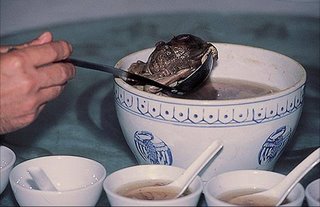

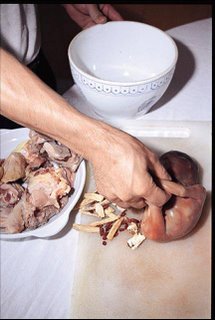

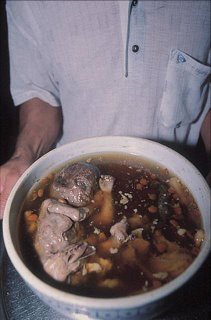
There's been a lot of articles flying around on the internet about the Chinese people in China eating aborted foetus as health food.
Did anybody see the movie 'Dumpling', starring Mirian Yeung and Tony Leung? It's about the wife of a prominent rich man who buys some special dumplings which will apparently sustain her youth and beauty. What she doesn't know is that the ingredients in the dumplings are made from minced foetus!
A lot of people has claimed that this is only an urban myth. After looking at the following pictures, I'm wondering if the stories are true somehow.
You can alo read more from the following article:
http://www.abortiontv.com/Glitch/AbortedBabiesSoldAsHealthFood.htm


Wednesday, September 06, 2006
Ghouls may come alive in museum
Not sure how many of you visited the 'Ghost' exhibition at the Shah Alam Museum. I didn't go myself probably because I was too scared :-) Anyway, there's so many articles in the newspapers recently about the exhibition.
The Director of Selangor Museum Board, Mohd Lotfi Nazar claims that 90% or the exhibits are real. Lotfi said he came up with the idea of exhibiting the ghost collection when he was involved in a project in Kuala Selangor. As he had a deep interest in the mystical world, several villagers who were also involved in the project convinced him to visit the Muzium Nurul A'la owned by Safuan Abu Bakar and which has rare items including a ghost collection.
Here are some pictures from the exhibition:
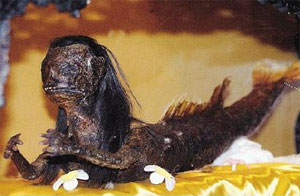

The following article was published in The Star yesterday:
The Director of Selangor Museum Board, Mohd Lotfi Nazar claims that 90% or the exhibits are real. Lotfi said he came up with the idea of exhibiting the ghost collection when he was involved in a project in Kuala Selangor. As he had a deep interest in the mystical world, several villagers who were also involved in the project convinced him to visit the Muzium Nurul A'la owned by Safuan Abu Bakar and which has rare items including a ghost collection.
Here are some pictures from the exhibition:


The following article was published in The Star yesterday:
The owner of the supernatural items being exhibited at the Sultan Alam Shah Museum here may finally have the opportunity to bring his “ghouls” to life.For me,I think it's all just a big publicity stunt to pull in the crowds. What do you guys think?
And if the event takes place, Safuan Abu Bakar will be doing it at an annual paranormal conference held in Britain.
Bob Rickard, founding editor of a British paranormal magazine, who visited the exhibition recently, said he would source for sponsors to send Safuan as well as his team and exhibits to Britain.
“I will speak to my publisher as well as others who may be interested in seeing Safuan bring his exhibits to life,” said Rickard who founded the monthly magazine Fortean Times more than 30 years ago.
Rickard who visited the exhibition after reading about it in The Star also had a lengthy discussion with Safuan at the museum.
Sufi master Safuan had claimed that he could bring some of the supernatural items such as langsuir (vampire) to life to prove that they were genuine.
However, he said he would respect the wishes of the religious authorities, which prohibited him from doing so on grounds that the action would contravene Islamic norms.
“I won’t do it in Malaysia but if Bob (Rickard) manages to get me sponsorship to do it in Britain, I will do it there as part of a paranormal experiment,” he said.
Meanwhile, Rickard described the exhibits as some of the best that he had seen.
“I have gone to many exhibitions highlighting similar items but they are nothing near to what I’ve seen here,” said Rickard.
He praised the museum authorities for organising the exhibition to give the Malaysian public a glimpse into their cultural heritage.
“It is an excellent effort by the museum to bring this topic into discussion as well as to open the people’s eyes to their own historical and cultural identity,” said Rickard.
Tuesday, September 05, 2006
Photo of Ghost Girl
 This photograph was taken by amateur photographer Tony O'Rahilly on 19th November 1995, as Wem Town Hall, Shropshire, England, burned to the ground. When O'Rahilly took the photo, neither he, nor other onlookers, saw the little girl in the doorway. The picture was taken with a 200mm lens from across the road because O'Rahilly and other onlookers were prevented by police and fire personnel from approaching the burning structure.
After the image was developed, O'Rahilly submitted it to the Association for the Scientific Study of Anomalous Phenomena. They, in turn, sent the picture and the negative to photographic expert Dr. Vernon Harrison, former president of the Royal Photographic Society. Dr. Harrison analyzed the print and negative and reported that he was satisfied that the picture is genuine. "The negative is a straight forward piece of black-&-white work and shows no sign of having been tampered with," said Harrison.
A fire ravaged the town hall once before in 1677. The historical record indicates that the 1677 fire was caused by a young girl named Jane Churm, who had been careless with a candle and set the thatched roof of her home on fire. Many people of the town have reported seeing her ghost in the years since 1677, and many residents believe this photo to be her.
Despite the international publicity and visits from teams of 'ghostbusters', the image of the girl in the photo has never been properly explained.
Skeptics, including Dr. Harrison, have claimed the child is nothing more than the convenient arrangement of smoke, flame, light, and shadow at the moment of exposure. But what are the odds of smoke, flame, light, and shadow randomly forming the shape of a girl in the doorway of a building allegedly haunted by a girl, at the very moment a photographer took this picture?
Monday, September 04, 2006
Friday, September 01, 2006
Sea-Monster or Shark
On the 25th of April 1977, a Japanese trawler named Zuiyo Maru was trawling for mackerel about 30 miles east of Christchurch, New Zealand when it caught a strange, unknown creature in its net. The creature was thirty-three feet long and weighed about four thousand pounds. It had a one and a half meter long neck, four large, reddish fins and a tail about two meters long (which sort of resembles the Loch Ness monster).
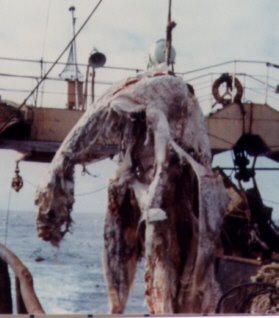 The crew was convinced it was an unidentified creature, but despite the potential biological significance of the curious discovery, the captain decided to dump the carcass into the ocean again so not to risk spoiling the caught fish. However, before that, some photos and sketches were taken of the creature, measurements were taken and some samples of skeleton, skin and fins were collected for further analysis by experts in Japan.
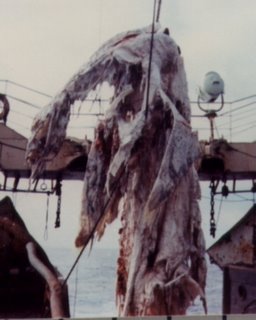 The discovery resulted in immense commotion in Japan. Professor Tokio Shimaka from Yokohama University was convinced that the remains was of a supposedly extinct plesiousaur (or prehistoric 'sea-monster'). However, other scientists were more skeptical.
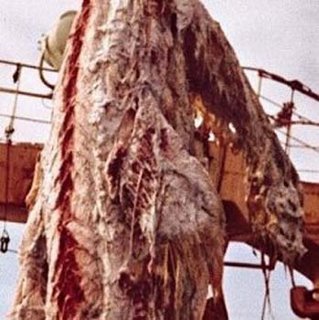 So was this a great basking shark or was it a relic from the past, a dinosaur or some other imcredible creature that may still live in our oceans today, trawling the depths of the only last undiscovered country on the planet. Other scientists have argued that it was actually a decayed basking shark.
So was this a great basking shark or was it a prehistoric sea-monster?
Wednesday, August 30, 2006
'Merman' mystery unfolds
A day after I posted the 'Merman' story on my blog, David Emery (who writes for Urban Legends and Folklore in About.com) wrote about the same story and his insight into the so-called mystery.
As I mentioned, the pictures were first posted in eBay by a seller who calls himself 'seamystery'. Apparently, 'seamystery' has auctioned off items like this before, including one specimen billed as a Feejee Mermaid which incidentally was also up on sale on the website of a taxidermy artist Juan Cabana. If you go to his website http://www.thefeejeemermaid.com/ you will see a picture of the 'merman' there.
David Emery wrote to Juan Cabana and asked, "Is this one of your creations?" To which he replied, "I got that photo from a fan of my site so I put it up. Never saw it before in my life. Looks real to me."
Emery points out that while Juan Cabana is well known among aficionados of "gaff art" (the construction of sideshow artifacts) and has even been publicly lauded for the quality of his work, he customarily pretends that the artifacts were discovered, not made. It's the "performance" aspect of the art, you might say. From time to time he does take credit for fabricating the objects, however, as when he appeared on George Noory's "Coast to Coast" radio show, for example, to discuss his "fantastic creations made from such elements as fish & animal remains, steel and fiberglass." And what should appear next to Cabana's name on the "Coast to Coast" Web site but a picture of the "merman" himself!
Sunday, August 27, 2006
'Merman' found in Teluk Bahang
Photos of a 'merman' has been circulating on the Internet recently. It was supposedly caught by a fisherman in Teluk Bahang beach in Penang. The 6 photos of the creature, taken from various angles, were attached to an email titled "Teluk Bahang Fisherman Found This! Newspaper Not Allowed To Publish?" When a reader forwarded the email to a local Chinese newspaper, the Department of Fisheries was contacted to find out more about the creature. An official from the department said that they had not received any reports about the odd catch, nor had they ever heard anything about such a creature. He requested that the photos of the creature's body be forwarded to his department so they could verify the incident.
The creature is vaguely humanoid in shape, its body is roughly the length of an adult man, with two long fins that resemble large ears on its head. It also has two arm-like projections, and is covered in gleaming scales. Did this creature really turn up in Teluk Bahang, or is this just a clever hoax? The photos certainly look real. If they are fakes, then a lot of skill and effort must have gone into making them.
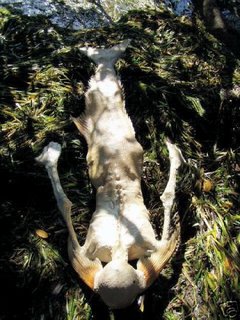
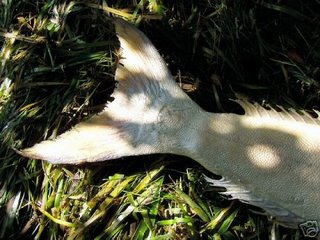
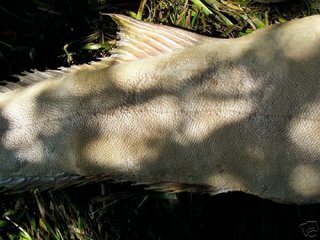
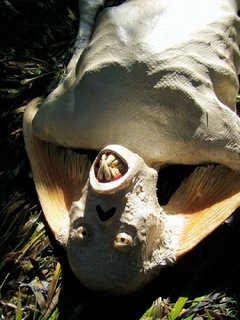
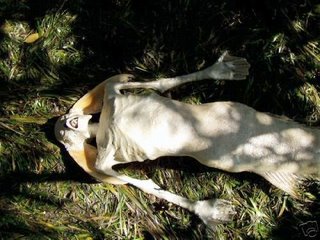

The creature is vaguely humanoid in shape, its body is roughly the length of an adult man, with two long fins that resemble large ears on its head. It also has two arm-like projections, and is covered in gleaming scales. Did this creature really turn up in Teluk Bahang, or is this just a clever hoax? The photos certainly look real. If they are fakes, then a lot of skill and effort must have gone into making them.
Footnote: After searching through the internet, I found out that the pictures were actually from eBay. The seller in eBay claims that the creature was found in Fort Desoto Beach in Florida. The seller's id is seamystery. The bid was closed on July 06. The circulation of the pictures in Malaysia only started in August. So this explains that the creature was never found in Teluk Bahang. However, the question still lies as in whether the creature is real or fake. The winning bidder is mysterymuseum. His feedback on eBay was "REAL GOLDEN Mermaid - A Million Dollar Attraction - MYSTERYMUSEUM.COM-A++++"
What is Forteana?
 Everybody loves a good mystery. From conspiracy theories and paranormal phenomenas to ghost stories and urban legends, people have always been fascinated by the unknown and the unexplained.
Forteana (or Fortean phenomena), named after Charles Fort, refers to the strange and anomalous phenomena which are rejected by mainstream science. Charles Fort (1874 - 1932) was an American writer and researcher into unexplained phenomena. For over thirty years, Fort sat in the libraries of New York and London trying to find reports of what are now popularly called “anomalies,” things that aren’t what they are supposed to be…especially in the eyes of science. By 1930 he had collected “some 60,000” of them, mostly jotted down on scraps of butcher’s paper. Fort was sceptical of scientific explanations, observing how scientists argued according to their own beliefs rather than the rules of evidence and that inconvenient data was ignored, suppressed, discreditedor explained away. Fort is considered by many as the father of modern paranormalism, not only because of his interest in strange phenomena, but because of his "modern" attitude towards religion, 19th century spiritualism, and scientific dogma.
Even though I do not believe in all the stories that I read and hear, I still keep an open mind on them and am very fascinated by them. I read and collect as much information about these subjects as I can as a hobby. I don't make assumptions about the information or draw any conclusions. I hope my friends and readers will share their experiences with me on this blog as well.
Subscribe to:
Posts (Atom)